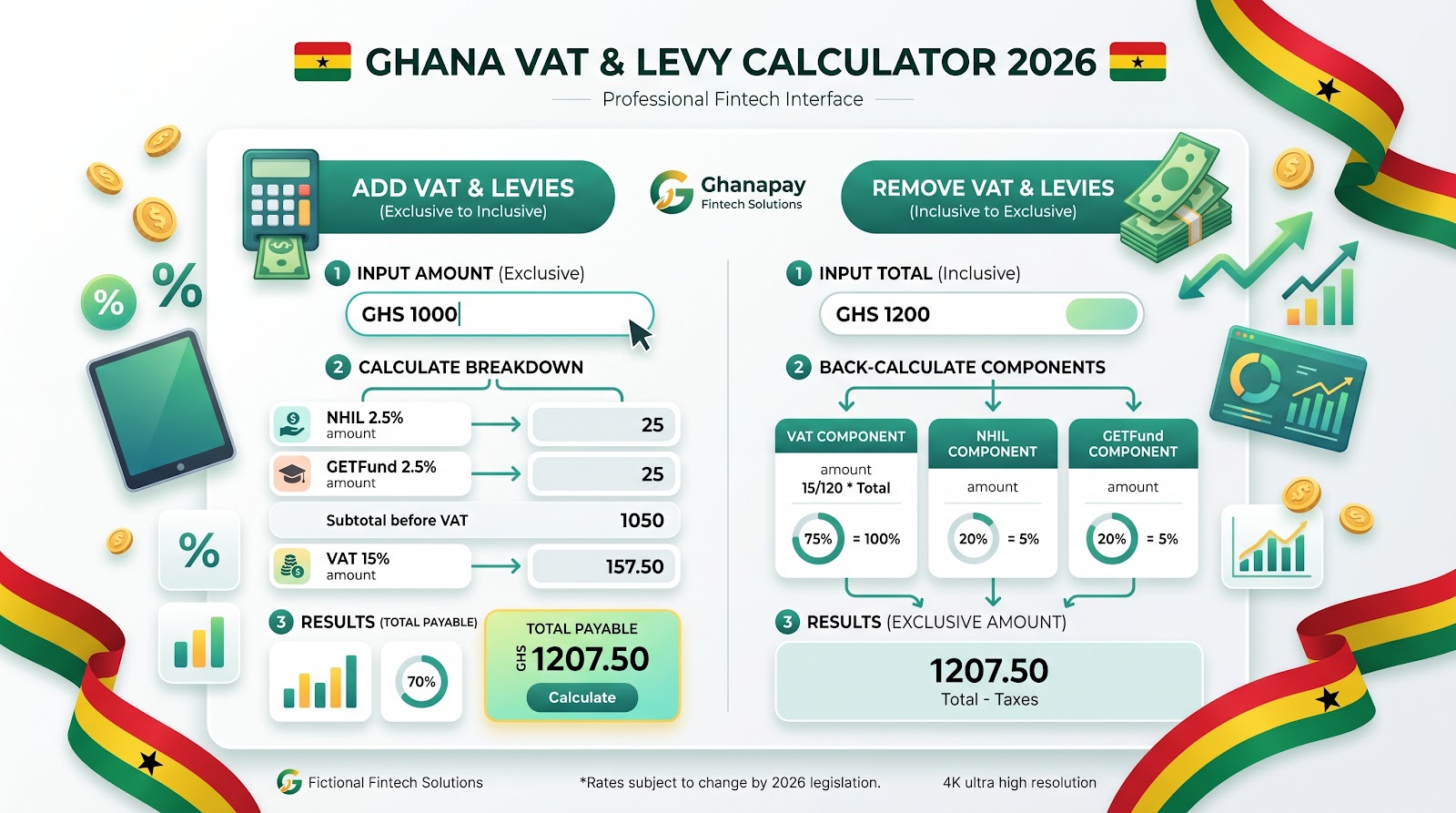
2026 Ghana VAT & Levy Calculator
Verified for 2026 Fiscal Reset (Act 1151)
The Ultimate 2026 Guide to Ghana's VAT & Levy System
Understanding the tax landscape in Ghana is crucial for business sustainability and consumer awareness. Following the 2026 Fiscal Reset and the passing of Act 1151, the Ghana Revenue Authority (GRA) has moved toward a unified tax structure. This guide provides a deep dive into how these changes affect you.
How the 20% Effective Rate Works
In previous years, Ghana utilized a "cascading" tax system where certain levies were calculated on top of others, leading to an effective rate of 21.9%. As of January 1, 2026, the 1% COVID-19 Health Recovery Levy has been abolished. Today, the three primary components—NHIL (2.5%), GETFund (2.5%), and VAT (15%)—are all calculated based on the same base price. This simplifies the effective tax rate to exactly 20%.
New 2026 VAT Registration Thresholds
To encourage Small and Medium Enterprises (SMEs), the government has adjusted the annual turnover threshold for mandatory VAT registration to GHS 750,000. Small traders and retailers falling below this mark are no longer required to charge VAT, though they may still register voluntarily to claim Input Tax Credits. However, professional service providers such as legal, accounting, and IT consultants must register regardless of their income.
Input Tax Credits: Why Accuracy Matters
For businesses in Accra, Kumasi, and beyond, claiming Input Tax Credits is the best way to manage business costs. When you pay VAT on goods or services for your business, you can deduct that amount from the VAT you collect from customers. Accuracy in these calculations ensures you do not overpay the GRA or face penalties during an audit. Our tool above is designed to provide this precision instantly.